


Case Study
'An invaluable process, making us a more pro-active organisation'
“It has created a model for how we want to work as an organisation… We’ll be more evidence-based with our decision making and more proactive, whereas we’ve been largely reactive in the past.”
“Trust Impact guided us through the right conversations at the right points in the process and allowed the whole group to have its voice heard. They did it in a really thoughtful way. The value of that has been enormous.”
– Richard Barron, CEO, Hampton Fund
Since 1811, the Hampton Fund has supported people in need in the London Borough of Richmond through grants to individuals, local charities, voluntary sector organisations and community groups. Those 200+ years have given them intricate knowledge of their local area, but over time their strategic direction and precise role in the Borough’s ecosystem has somewhat lost focus.
Traditionally, the Hampton Fund’s purpose has centred around alleviating fuel poverty, which back in the 19th century literally meant distributing wood and coal to the poor. Fuel poverty is still affecting people over two centuries later in what is one of London’s more affluent areas – in addition to social isolation, mental health and many other issues. In response, the Hampton Fund serves 2,000 annual grants to individuals and around 50 local organisations who in turn support those in most need.
THE CHALLENGE
By the time Richard Barron became its new CEO in December 2023, several factors had affected the Hampton Fund’s position. In the short term, it had been a difficult period due to prolonged illnesses to two key staff members (out of a total staff of just five, plus 12 Trustees). Also, another funder, Richmond Parish Lands Charity (RPLC), had just completed its own strategic review and a placed-based giving initiative, One Richmond (created by RPLC and Hampton Fund), had recently achieved CIO status. Understanding of Hampton Fund’s role in relation to these new developments was needed. Covid and the cost-of-living crisis had also deepened local people’s level of need, and Hampton Fund’s grant spend had increased by 30% in response.
There was growing acknowledgement that a new framework for grant-giving was needed so that the organisation could make a more durable impact. It was in this context that Richard called upon Trust Impact to help work towards some immediate objectives:
- Help establish clear strategic direction through better definition of their core purpose
- Set a new framework and parameters for grant giving
- Define their unique role in Richmond’s local eco-system
“It was a long time since the organisation had taken stock of what it was actually there for,” says Richard. “Our two programmes [individual grants and community grants] were effective in their own right, but the way they operated had grown organically over time and grant-making needed to realign under one purpose. I also wanted to look at how we could increase our focus on impact.”

DEFINING THEIR PURPOSE
Trust Impact’s first intervention was to help staff and Trustees agree a common purpose statement using its Purpose Alignment Tool.
“Before we could think about a new strategy, we needed clarity on why we’re here and who we’re here for,” reflected Richard. “The Purpose Alignment Tool was a really good starting point for discussion because it was obvious right away there were many different views around the table from staff; our two grant committees were using different terminology and were placing emphasis in different areas.”
One key discussion that Trust Impact navigated was the difference between the impact of grants to individuals and those to community organisations. The Hampton Fund funded a wide range of community organisations, including Scouts troops, arts projects and theatres, but the discussions facilitated by Trust Impact enabled staff to identify that their community grants should be targeted towards organisations that in turn use that money to help individuals and families. “We realised that, at the end of the day, everything we do is about reaching individuals in need,” says Richard. “That was incredibly helpful.”
But which individuals do (or should) they support? This question was important as it was felt that the precise need they were there to serve had gradually become more nebulous. They needed to define who they would (and would not) support going forward. Richard describes it as a “funnel” where the widest part at the top is “funding anything and everything” and the bottom is very strict and specific. They needed to identify the cut-off line. Trust Impact helped them do so.
Through workshops and interviews, Trust Impact’s Sam Ellison and Adrienne Skelton helped Trustees and staff identify a series of ‘strategic tensions’; specific issues on which it wasn’t quite clear where the organisation rested. They were asked to plot on a spectrum what was important for them on these issues. “It was an extremely valuable process,” says Richard. “The conversations showed that mostly people were in alignment, they just expressed the issue very differently or were looking at it from a different perspective. The process showed that there was nothing we couldn’t get past.”
These discussions led to coalescence around specific terminology which everyone felt accurately defined the organisation’s role in Richmond. One key word was ‘hardship’.
Sam and Adrienne shared material (including Joseph Rowntree Foundation’s 2023 report, Designing out Hardship and Destitution) to stimulate thinking around the Hampton Fund’s role in responding to people’s experiences of poverty. This helped staff and Trustees understand the need to focus support on the left-hand side of the ‘survive to thrive’ model (below). It also highlighted the national circumstances that were pulling more people into hardship, which resonated with what staff were seeing in Richmond. It helped them understand that the impact of hardship is multi-faceted and that their support needed to reflect this, covering financial, practical and social needs.
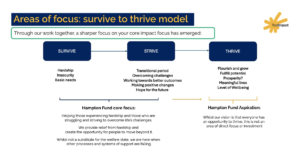
“‘Hardship’ felt like the place everybody was most comfortable,” says Richard. “‘Vulnerability’ or ‘disadvantage’ felt too broad. Once we’d settled on the terms ‘individuals’ and ‘hardship’, we gained clarity on the need we’re trying to address, and we were able to define a purpose around that. Where previously the two grant programmes sat as very separate entities, now we could see them both as part of the same purpose.”
THE THEORY OF CHANGE
Defining a purpose statement enabled a smaller group to work with Trust Impact on formulating a Theory of Change – breaking down the process by which Hampton Fund achieves its outcomes and impact, which were set against its defined purpose.
Having a clear purpose was a sound basis to change ways of working. For example, were grants always the best way of addressing hardship, or could they collaborate with other charities or the local council to achieve their purpose and make a better impact? Setting a clear framework of what impact should look like helped map a clearer path to achieving it – and recognised the organisation’s role as part of a local eco-system of support organisations, which they should work with in order to deliver against the Theory of Change.
Having almost reached the end of the development of the Theory of Change, Hampton Fund decided to complete the finished version on their own. “Trust Impact had given us enough confidence to go ahead ourselves and helped earn the buy-in from staff and Trustees. It felt like the stabilisers had come off,” says Richard
Adrienne, Trust Impact’s Lead Impact Consultant, said: “It’s always a great outcome when an organisation feels ready to move forward without us because it means that any uncertainties have been resolved, there is clarity about the impact they are aiming to make – and they feel ready to make it!”
Working in accordance with the Theory of Change has led to some difficult changes in operations – such as changing funding criteria and application processes, but the process had earned the support and trust of staff and Trustees which made those changes much easier than they might have been otherwise.
IMPACT
The Theory of Change and renewed focus on delivering against a clearly defined purpose has brought immediate improvements to Hampton Fund. “This model enables us to become more systematic and evidence-based in our decision making,” says Richard. “We’re now in a position where we will be making decisions about how we allocate money based on local need and local priorities.
“It will also make us a more proactive organisation, whereas we’ve been largely reactive in the past. Our application process was very open and we hadn’t really thought about how we directed money towards particular areas or against particular themes or issues. We’re now in a position to say, ‘The evidence is showing us there’s an issue here. Is our grant making a solution to that? Or is it collaborating through our local connections?”
Coming in as a new CEO and implementing such a degree of change is never easy, and Richard acknowledges the importance of Trust Impact in helping him manoeuvre through this tricky process while securing and maintaining the support of staff and Trustees.
“It was really important that there was a third party involved, so it wasn’t just me coming in and saying, ‘We need to do everything differently!'” he says. “Having someone facilitating this process, so it felt like there was a methodology to it that people could see and understand, and that everybody felt involved in the discussion and decision-making – that’s what Trust Impact delivered. If they hadn’t had the right gravitas and credibility, I expect I would have encountered resistance, but they presented themselves in such a way that that wasn’t an issue.”
He adds: “If I look over the whole process, the real value was leading us through the right conversations at the right points in the process and allowing the whole group to have its voice heard. They did it in a really thoughtful way. The value of that has been enormous.”