


Case Study
How Gordon Moody Have Used Live Data To Increase Funding and Improve Operations
“Our financial position has changed dramatically, and we could not have done that without Trust Impact giving us the tools to identify our purpose and demonstrate our impact. Trust Impact’s data visualisation tool helps me make decisions every day. It is exactly what we wanted to bring data alive across the business.”
Matthew Hickey, CEO, Gordon Moody
When Matthew Hickey became the new CEO of gambling therapy charity Gordon Moody in February 2020, he enlisted Trust Impact’s help to revolutionise its services. He describes the change that has taken place across the organisation since then as “utterly phenomenal”.
“When I arrived, all the decision making within Gordon Moody was done by gut feeling,” says Matthew. “We were a small organisation with a lot of data but no real understanding of what it meant or how to put it to use. That made it difficult to articulate who we were and what we do. There were so many loose ends.”
Over many months, Trust Impact has worked with Gordon Moody’s senior management team to totally transform how it records, interprets, presents and uses its data. This has had many profound knock-on effects on the organisation’s scale and success.
Trust Impact’s early work with the charity centred around identifying its core purpose and the creation of a theory of change – breaking down the process by which it achieves its impact.

Trust Impact helped implement automated electronic surveys with Gordon Moody’s clients to collect data which would clearly show the difference the charity’s treatment had made to their desistance from gambling and their overall wellbeing. To measure this, they used the Problem Gambling Severity Index (PGSI) and Core-10 monitoring tool, which monitors anxiety, depression, trauma, physical problems and risk to self.
Along with Dragos Dragomir, Gordon Moody’s Clinical Director, Trust Impact used the data to create a live dashboard drawing data directly from the charity’s database called Apricot. The dashboard, updated in real-time with multiple data sets recording every contact with a client, quickly became the cornerstone for all decision-making within the organisation.
Trust Impact’s initial research showed that Gordon Moody’s most valued service was its intensive treatment for those whose lives are most severely affected by gambling. This consists of a 14-week residential recovery programme and a ‘halfway house’ aftercare programme to prevent relapse. The charity had lots of other types of support, but feedback showed its services at the highest end of need were its most important.
“That data offered us real clarity of purpose,” says Matthew. “It cemented our raison d’etre – to offer residential treatment for those most severely affected by gambling disorders. We realised the remote and softer-touch services are covered by others in the UK market.”
The initial feedback data led to the charity developing relationships with early intervention services who could refer clients on to Gordon Moody when they required more intense forms of treatment. It essentially led to a rebrand from a B2B to a B2C organisation.
By 1 April 2023, Gordon Moody will have increased bed space at its three facilities in Manchester, Wolverhampton, and Dudley from 90 to 260 with over 80 staff, and its retreat counselling programme will have doubled in size.
“We’ve gone from a small player to an organisation of real influence in this marketplace,” says Matthew. “We’re being listened to by government, academia and key industry decision makers. That all comes back to having data visualisation which really amplifies who we are.”
The data visualisation not only gives a clear picture of the charity’s impact to funders, it provides a robust foundation for decision making.
“Previously, we didn’t really know what the data was telling us,” says Matthew. “We couldn’t tell what the trends were, what the client experience was, how we could improve the product set, whether we should expand a service, and so on.
“We now have data visualisation which allows us as a business to see the number of people applying to us, information about them, how long it takes between their application and being spoken to, how long until they’re assessed, time until residential treatment, what their treatment journey is like and where are they on our two key measures [PGSI and Core-10].
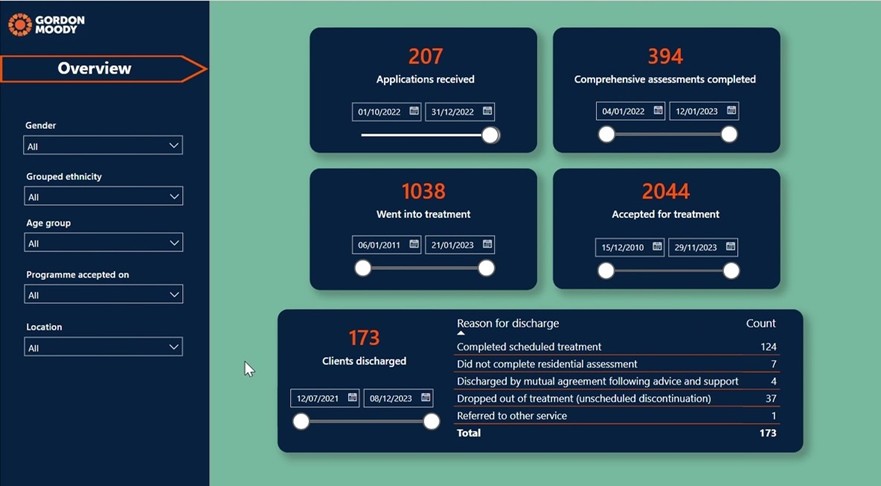
“We can show where they are at the start and where they are at the finish – and that is the most powerful data of all. We can demonstrate that nobody else is delivering transformational change to the level that we are.
“Without the work of Trust Impact, we wouldn’t be in the position we are now. We may have got there eventually, but the visualisation and interpretation of the data has infinitely sped up our ability to make the right decisions at the right time.”
Being able to articulate its impact enabled Gordon Moody to tell a far more powerful story to commissioners and its major funders in the gambling industry. As Matthew succinctly put it, “It gave us the balls to go out and ask for more!”
Since working with Trust Impact, the charity’s income has grown from £1.4m to a projected £7m by March 2024.
Matthew says: “Our financial position has changed dramatically, and we could not have done that without Trust Impact giving us the tools to identify our purpose and demonstrate our impact. They’ve put us in a position where we are incredibly comfortable and confident with our numbers.
“The visualisation tool helps me make decisions every day. I am going to use the word ‘phenomenal’. It is exactly what we wanted to bring data alive across the business.”
By using the ConnectMixShare data sharing platform, the charity can automatically send questionnaires to beneficiaries at three-month intervals to monitor their progress with gambling desistance and psychological wellbeing after they have left residential treatment. Their responses are automatically analysed and will be picked up by a flagging system if they give cause for concern. This system has, literally, proved to be life-saving.
Dragos explains: “The answers given by a service user can indicate if they have relapsed or they are struggling with suicide or self-harm ideation. This triggers our flagging system, notifying one of our staff members, who can reach out to the service users. That is how important the data can be.”
Gordon Moody has developed a service specifically for women, which is shorter and more intense than its men’s equivalent. Once again, it was data that provided funders with the necessary evidence that this specialist clinical service at a new facility was needed.
As their data becomes ever more robust and provides deeper insight, it’s no surprise that it has attracted interest from inside and beyond the sector. The charity has now employed a Research and Evaluation Lead, Rosalind Baker-Frampton, part of whose role is to manage relationships with the academic community who want to use the charity’s data in research.
“One of our key drivers going forward is to be thought leaders in the sector and our data enables us to take that role with confidence,” said Matthew.
The other element to Rosalind’s role is to extract maximum value from the data. She was recruited quite simply because the charity’s senior management team were so excited about what more they could learn.
Dragos says: “Some people just use their dashboard to build reports, but we are certainly not going to stop here. All we can think about is where we can go next with Trust Impact. How can we build on this? Where can this tool take us next? It’s so interesting that we wanted to put more resource into extrapolating even more insight.”
Working with Trust Impact has transformed Gordon Moody’s way of working, with data now at the heart of all key decisions, direction of growth, expansion of property and income and the content of its services.
Matthew’s praise is effusive: “In terms of the difference they have made to our performance, Trust Impact should seriously be putting themselves forward for an award. I would happily make the application on their behalf!”